

ROCHFORD HUNDRED 28 CANTERBURY 26
by David Haigh
Going into this game Canterbury Head Coach Matt Corker warned that relegation threatened Rochford would fight like wounded animals after their mauling by Barnes the previous week. Fight they did and so effectively that they edged a tight contest which brought Canterbury two bonus points but disappointment that they could not maintain their recent improved form. Despite starting positively and leading at the break they were too casual and inaccurate to put away some decent first half chances and those failures came to bite them. Harvey Furneaux’s seventh minute try, converted by Frank Reynolds, made Rochford look vulnerable but they soon put that idea to rest. Fly half Tauren Henwood stepped neatly through midfield with a quick reply but it was the city side who held the attacking edge. The forwards did the work again for a Billy Young try, which left Reynolds an easy kick, but that was all they could find. On the stroke of halftime Chris Dudman’s penalty goal sliced the Canterbury lead to six points and they were soon under pressure from a fired up home side after the restart. It earned Rochford territory and penalties and two from the boot of Dudman brought the scores level. Going into the last quarter a disjointed Canterbury, who did not look after the ball, fell behind to a converted try by Rory Gray but then found some momentum of their own. It brought a close quarters try for Dave Irvine, topped up by Reynolds, but missed tackles handed centre Sam Cappaert the hosts a third touchdown with eight minutes left. Dudman’s successful kick left the city side needing a converted score to salvage a draw and they gave the ball width to send Ben Cooper over for a bonus point try. Reynolds was faced with a difficult conversion, which he narrowly missed, and Rochford’s second half battling performance was rewarded.
Canterbury: W.Waddington, G.Hilton (rel C.Kingsman), S.Sterling, L.Hollidge, F.Morgan, F.Reynolds, B.Cooper (repl T.Williams), B.Young (repl C.Macmillan), N.Morris (repl E.O’Donoghue), D.Herriott (repl E.Lusher), D.Irvine, J.Stephens, H.Furneaux, C.Murray, T.Oliver.
View match photos


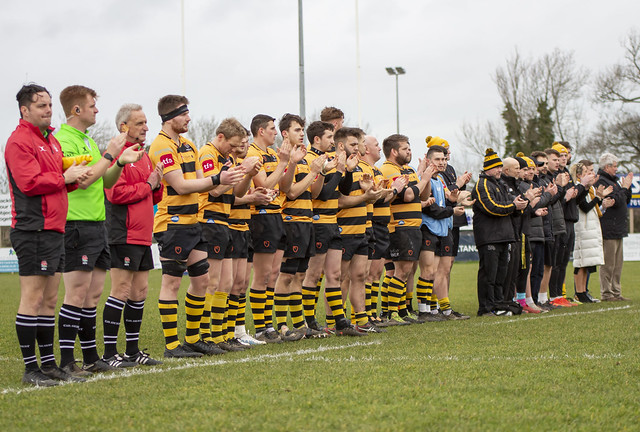


 We have learned with great sadness that one of the club’s stalwarts over many seasons, Benny Bell, has died. Benny served our club in a variety of roles, as player, sectary, treasurer, and international ticket officer. Former club president Steve Uglow pays this tribute. “Benny Bell made the wise decision to leave Maidstone and join Canterbury, playing his first match for the Pilgrims in 1976. He was a talented winger with a good turn of pace, playing regularly for the 1st XV and the Pilgrims. Age was beginning to catch up but Benny loved the game and was happy to play whether it was the Pilgrims or the Cardinals. In between scoring hatfulls of tries, he took pleasure in discussing the finer points of the laws of the game with the referee, often from the other side of the field. A change in direction came in the 3rd XV under my captaincy – it was an international Saturday and an early morning kick-off at Merton Lane when I confessed to failing to find a scrum half and was begging for volunteers. Benny raised his hand, had a super game AND was too tired to criticise the ref. It was a win-win. By the end of the season, he was playing 1st XV rugby. At the end of season club supper, Benny (in his late thirties) was given the ‘most improved’ player award. When he stopped playing, Benny threw his heart and soul into the role of club secretary as well as appointing himself as resident thorn-in-the-side of the club chairman. He was a Cumbrian by birth, from Hartsop, in Patterdale. And it showed – nothing got by on-the-nod and Benny would always dig down and check and then check again. He was a man for detail. But it was always the good of Canterbury Rugby that was uppermost in his mind. In recent seasons, he was always to be found on the touchline, staying involved in the changes in playing membership and coaching. In this, as in so many other areas, he was a man of many opinions, some of them (by the law of averages) right. He also had the disconcerting habit of remembering matches in the dim and distant past, blow by blow, scores, and scorers. Incidents that one had forgotten and wished to keep that way….”